

Waikalua Loko I’a was built about 350 years ago. At that time, the ahupua’a flourished with productive lo’i kalo (taro patches) fed by the waters of Kawa and Kāne’ohe streams.
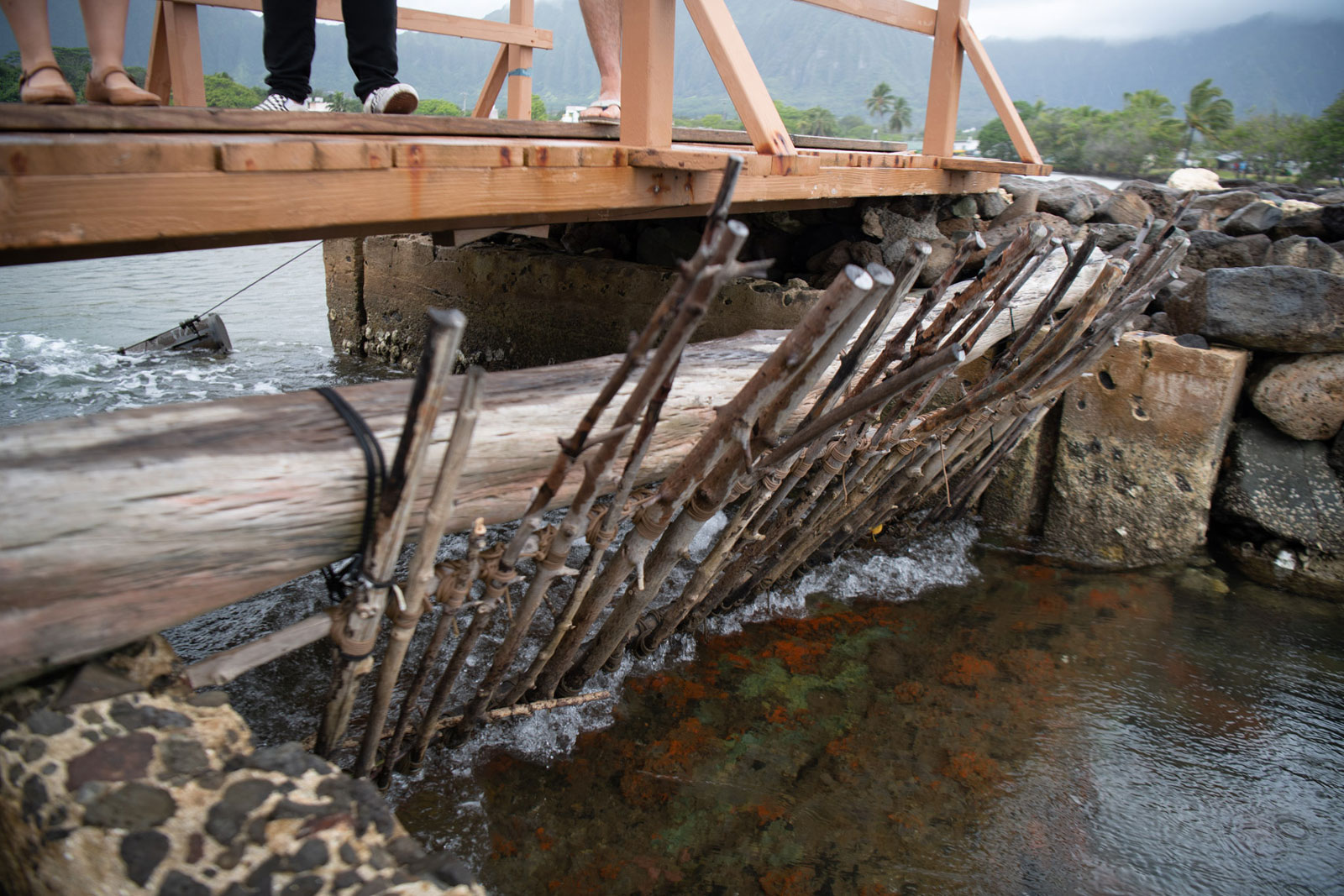
The waters flowed from the streams through ‘auwai (ditches) into the loʻi and into the loko I’a (fishponds). The original pond received fresh water from both Kāneʻohe and Kawa streams. Grates once controlled the flow of water from these streams into the pond so that pond managers could control the salinity of the water.
The original locations of the mākāhā (sluice grates) on the makai side and the dimensions of the pond walls are not known. The current sea levels are higher than at any time in the past, due to climate change.
In 2016, the Society declared its 20 year mission to restore the fishpond complete, and ownership was transferred to the Pacific American Foundation.
Ongoing restoration efforts, educational projects, water quality testing and data analysis, and cultural activities are enjoyed by students, families, and community.
Present day issues being addressed include climate change, sea level rise, pollution, invasive species, and safe, plentiful food cultivation using a combination of ancient practice and knowledge and modern scientific inquiry and practice.
The Waikalua Loko Fishpond Preservation Society in partnership with PAF develops a new model for culture -based curriculum utilizing the pond as the cultural resource to teach math, science, social studies and language arts.
The Native Hawaiian Education Council in 2005 selects the Kahea Loko curriculum project as a new model and helps to publish it online. In 2007, the Hawaii Department of Education awards PAF a “partners in excellence award for Kahea Loko and the new Aloha aina (ahupua’a) curriculum projects. To date, nearly 1,500 teachers are trained reaching nearly 50,000 students statewide. Between 3 to 5,000 students/community member visit and or conduct classes at the pond yearly.
In 1989, a Japanese company known as the Pacific Atlas Hawaii buys the golf course from the Ukauka family including the fishpond from Henry Wong with the intent of expanding the golf course to a championship course from a small par 3 course that it used to be.
Pacific Atlas gets approvals in 1994 but has to preserve the pond. In that process, I make an agreement with the City Council, Mayor and the Japanese owner to start a non-profit organization to steward the pond without any control from the city or landowner. In 1995, I form the WLFPS with the help of the owner to pay for the attorney fees. In 1998, Pacific Atlas goes bankrupt. Two other owners buy the golf course and pond since then. Current owner K-Bay LLC also going into foreclosure with Central Pacific Bank as the title holder.
Queen Kalama, wife of Kamehameha III (Kauikeaouli) was very fond of the pond. After the great mahele in 1848, the King and Queen retained ownership of the pond(s) in the area.
Kane’ohe was considered “aina Momona” and the Alii loved the area.
Kamehameha III is the son of Kamehameha the great and Keopuolani (she is considered the highest rank of any living Hawaiian) Kamehameha III is also the longest reigning King 1824-1854 of all Hawaii’s Kings. Kalama is considered a maka’ainana rank…
Charles Coffin Harris, originally lawyer from New Hampshire, gains the favor the King Kamehameha V and becomes minister of foreign affairs, and eventually Chief Justice of the Hawaiian Supreme Court serving all the way to King Kalakaua’s time. C.C. Harris is either given or sold the Waikalua loko fishponds as we know it today. Harris dies in the early 1880’s and sells it to the Botelho brothers. The Botleho’s are the precursor to the James B. Castle ranch which includes most of Kaneohe and Kailua. Castle turns into Kaneohe Ranch that we know of today.
Henry Wong was a land manager for Kaneohe Ranch for over 35 years. Upon his retirement, he is given certain lands fro his good service to the ranch. It includes the Waikalua fishpond and what is known today as the Bayview golf course and surrounding area.
According to S. Kamakau, in the 13th century, a Tahitian chief known as La’amaikahiki sailed from Tahiti to Kane’ohe and landed at what is known as Waikalua.
(Note: Kihei’s research refers to the site as Waihaukalua or the place where Waikalua fishpond is today)
We suspect the name derives fom the two fresh water streams that boarder the pond, wai meaning freshwater and kalua, a contraction of ka elua, meaning the two.
La’amaikahiki named the area known as Waikalua and the Kokokahi Y site as Naoneala’a (the sands so La’a) It is considered the place that La’amaikahiki introduced the “pahu hula” in Hawaii. It is also known as a place to greet other pacific islanders.
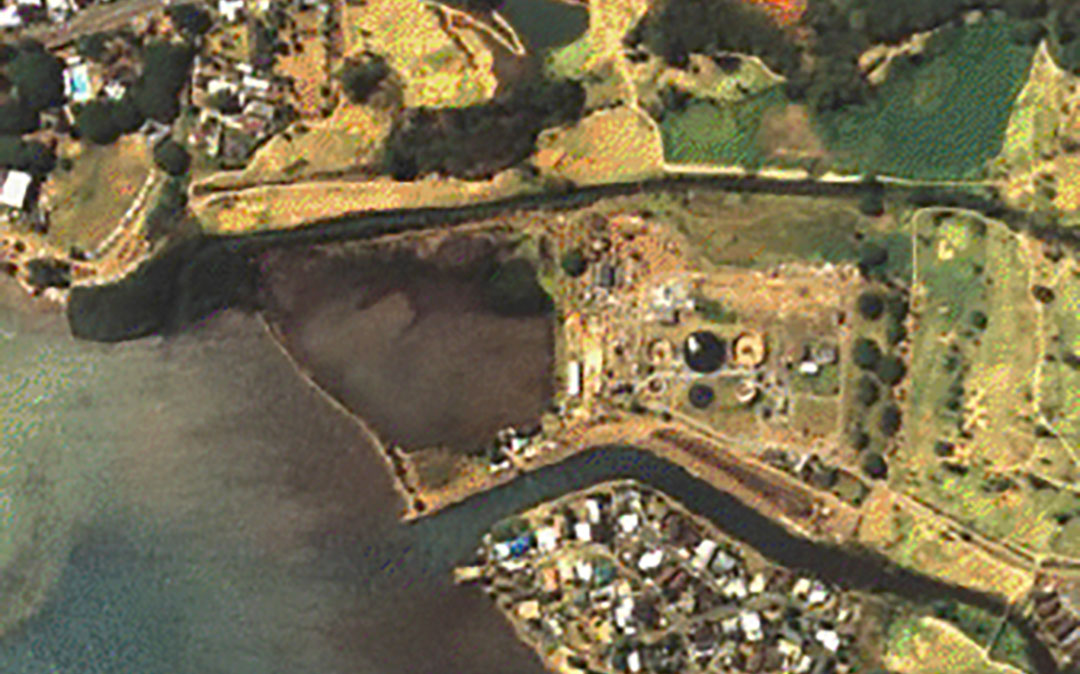
Timeline 1650 – 2022
| Early commercial era | |
| 1650 | Estimated date of original construction by Hawaiians. (Eugene Dashiell et al, 1995) |
| 1887 | The pond has extensive lo'i kalo mauka and a small interior pond where mullet fry were probably grown. |
| 1900 | The pond's area of 13.4 acres was in full commercial operation. (Today the pond is 11.6 acres.) |
| 1926 | There was a large break in the makai pond wall. |
| 1930 | The pond walls (mākāhā) were constructed of reinforced concrete, with stone faces filled with cobbles and coral, and with three openings. The 9 to 12 feet wide wall may have been widened for access by equipment. |
| Environmental decline | |
| 1940–1950 | Water quality and the marine environment were impacted by human activities. More than 11 million cubic yards of coral was dredged in Kāne'ohe Bay, and sugar and pineapple cultivation led to extensive soil erosion and siltation of the bay. A sewage outfall was constructed near Waikalua Loko. |
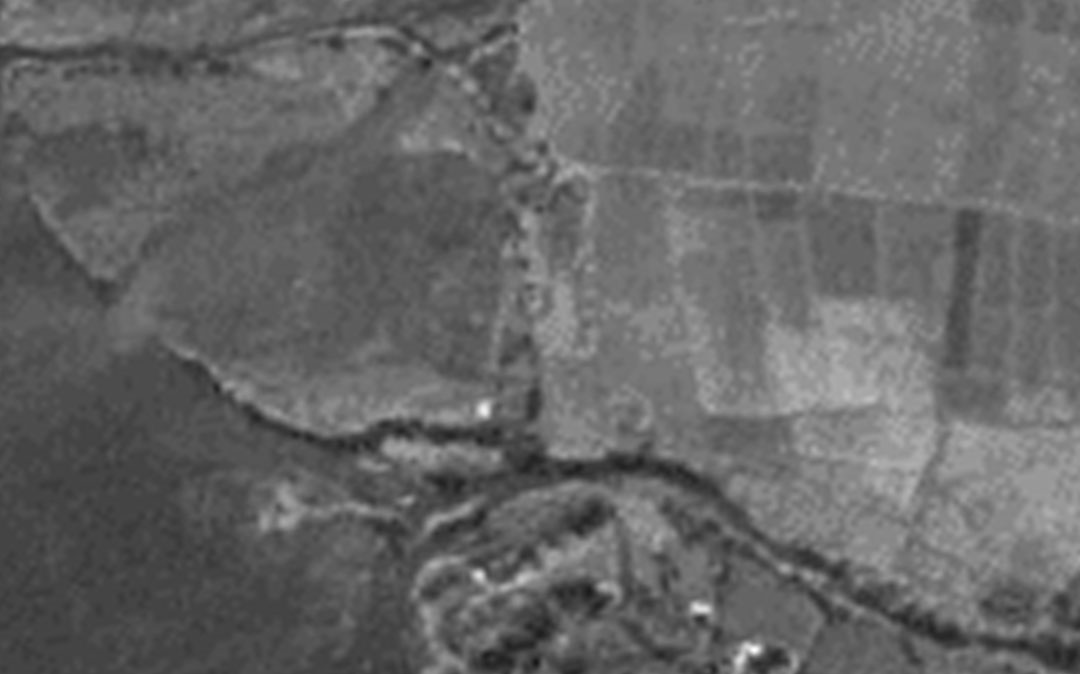
| 1967 | An aerial photo above shows a channelized Kawa Stream flowing directly into the bay. Ongoing development in the uplands of the Kāne'ohe ahupua'a created serious soil erosion. Introduced mangrove plants became a major management challenge. Mr. Koyama, the pond operator in the 1960s, reported a mullet harvest of only 100 pounds per month. |
| 1970 | Pond operation stopped. Flood control efforts led to channelization of Kāne'ohe Stream, which was dammed at Ho'omaluhia Park. Sewage discharge to Kāne'ohe Bay was stopped and diverted to Mōkapu Point. |
| Preservation & education era | |
| 1995 | The Waikalua Loko Fishpond Preservation Society was formed to help mālama the pond for use as an educational site. |
| 1998 | Castle High School science teacher Sheila Cyboron brings the first group of students (grades 11–12) to study science in the context of the fishpond. The transformation in student motivation inspires a new level of culture-based curriculum development. |
| 2000 | WLFPS partners with the Pacific American Foundation (PAF), the Hawaii Department of Education, and the University of Hawaii Sea Grant program, receiving its first major curriculum development grant from the U.S. Department of Education — "Kāhea Loko, the Call of the Pond." |
| 2003 | Kāhea Loko program is welcomed by teachers statewide; over 330 teachers sign up for training in the standards-based curriculum. |
| 2004 | PAF, the Society, and the Hawaii DOE receive a second major grant — "Aloha 'Āina" — focusing on the Kāne'ohe ahupua'a (mountain to the sea). |
| 2007 | Aloha 'Āina trains nearly 380 teachers. Both Kāhea Loko and Aloha 'Āina receive a "Partners in Education" award from the Hawaii Department of Education. |
| 2009 | In partnership with the University of Hawaiʻi at Windward and the Hawaii Institute of Marine Biology, the U.S. Department of Housing and Urban Development (HUD) awards a grant to purchase Waikalua Loko Fishpond and grant title to PAF. |
| 2011 | The Historic Hawai'i Foundation honors the Waikalua Loko Fishpond and the Society with its highest award for exemplary preservation of a cultural resource. |
| 2013 | PAF acquires Waikalua Loko (17+ acres) utilizing HUD funds — the first ancient Hawaiian fishpond to return to Hawaiian hands since the Great Māhele of 1848. |
| 2014 | PAF receives the "Kulia" award under the Native Hawaiian Education Act, focusing students in grades 7–12 on the Windward Side of Oahu on careers in natural resources management and marine science. PAF becomes a Hub partner with NOAA, EPA, HIMB, UH Windward, and the Smithsonian Institution. |
| 2015 | PAF Hawaii Inc. is created to maximize support from state and local governments as a long-term sustainable strategy for education, cultural preservation, and environmental stewardship. |
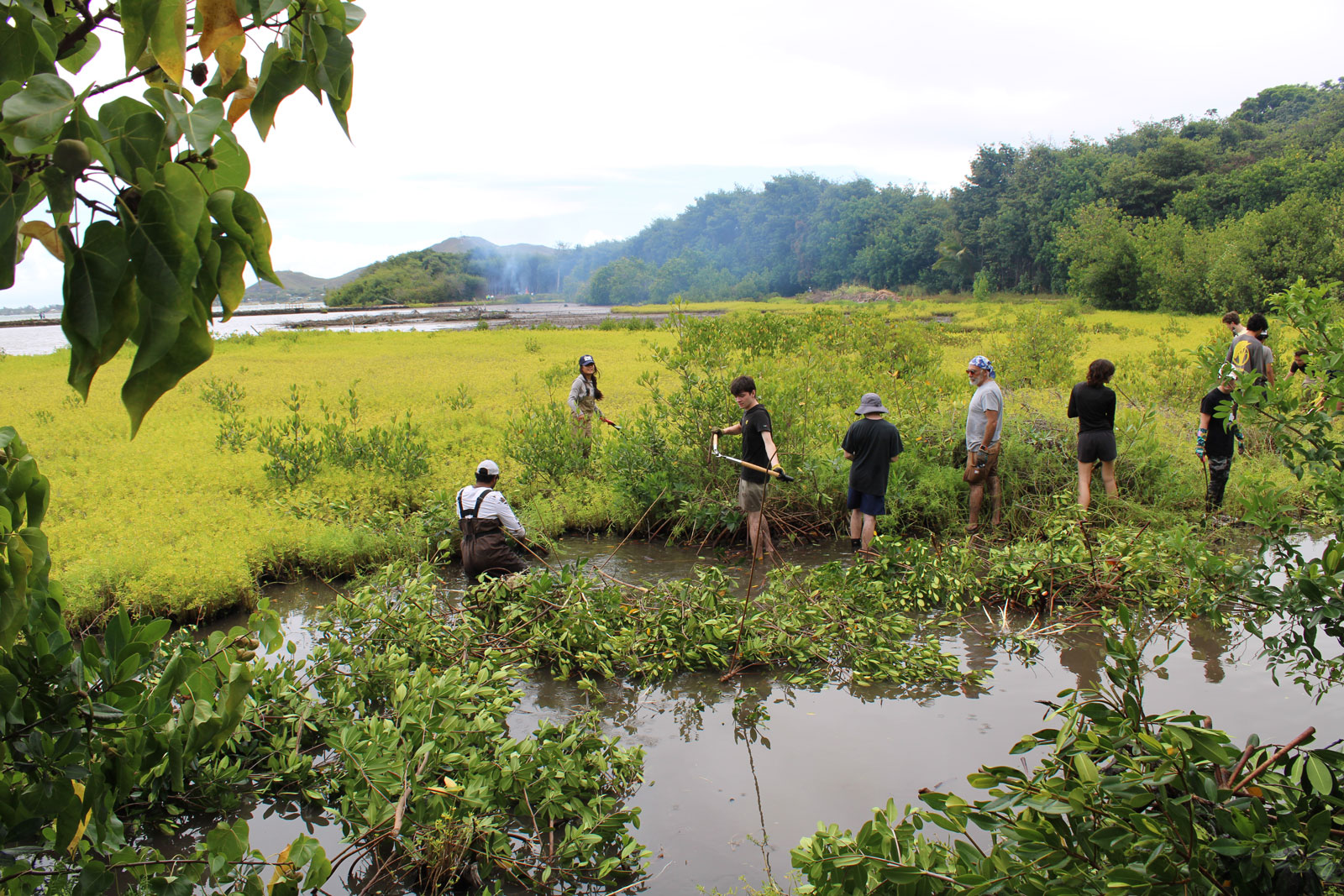
| Today | Since 2000, over 4,000 teachers have been trained in PAF's various curricula. Approximately 5,000 students, families, and community members visit the pond every year. Community members regularly come to care for the pond (Lā Hana) — removing invasive mangrove, seaweed, marine debris, and repairing walls. As each stone is put back on the wall and each native plant takes root, the foundation grows for a healthier future honoring the rich cultural and natural heritage of the Kāne'ohe ahupua'a. |

